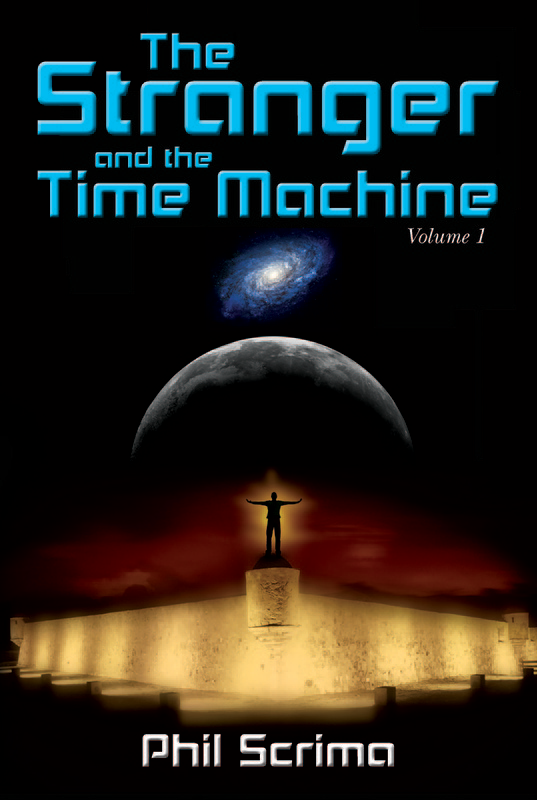
Travel back and forward in time with the Stranger. Each mission is action packed with different adventures. The reader will keep turning pages until the very end. Although these stories are science fiction, the author believes that the human race can obtain most of what is enclosed in these episodes. It will take many years and a united world working for the good of humanity, science, and the environment to make it happen. “We will be leaving your universe, and you will penetrate another dimension in time,” Alexis said. “This is beyond physics known in your world. We are about to enter a wormhole, which is a tube made of space-time that connects two different regions. This funnel tapers down to what is known as a throat. The exit can be partially pinched; however, hopefully we will connect to another funnel. You will then become transposed again, to pure energy and subatomic particles known as photons and electrons, what your scientists would call, quantum tunneling. If you survive, you will exit and enter our galaxy. We must avoid the black holes, as nothing escapes from them.”
Reviews
5.0 out of 5 STARS
Reviewed by Anna Call
January 6, 2014
Classic time travel story motifs aid an alien stranger in his mission to save the future.
Dealing with time travel and personal transformation, The Stranger and the Time Machine is a collection of four adventures through time. Each of the four sections of the book features a different mission. This episodic structure makes it easy to pick up the volume for a quick read, with each section standing on its own roughly as well as an episode of a TV show.
Bequeathed a time machine and a series of missions by his brilliant but eccentric uncle, the Stranger travels back and forth through history to right wrongs and preserve the fate of humanity. Along the way, he meets aliens, gunslingers, and the love of his life. Eventually, he trades his humanity for the greater potential of a future super-species.
The stories exist in the tradition of Doctor Who and Quantum Leap, featuring a central time-traveling character in a wide variety of settings and circumstances. As part of his time travel adventures, the Stranger must relinquish a large portion of his humanity, undergoing a series of stressful recoveries from long journeys through time.
Telegraphing of plot points represents a major flaw in this book, often disrupting the story’s illusion by stating what should instead be implied descriptively. The heavy-handed foreshadowing around the Stranger’s love interest is a good example: she is tagged as such two chapters before she actually appears. The book tends to follow well-trodden sci-fi themes.
That said, The Stranger and the Time Machine is a safe bet for fans of the genre. Because the book rarely deviates from motifs such as aliens, time travel, military training, and quasi-holy missions, readers who simply can’t get enough of this type of material may appreciate it, but those seeking original content or a higher level of storytelling sophistication may not be fully satisfied.
Exposition in the second half does much to humanize the Stranger, but by that point, he has been remade into an alien and has taken on an almost shamanic quality. However, his personal growth (with the encouragement of his alien sponsors) is appealing, and as the book continues, enjoying the character becomes increasingly easy. Side characters, including a generous sampling of interesting nonhumans, are developed well, not only as members of the Stranger’s journey, but as independent beings.
The book ends without really wrapping up, indicating an ongoing progression into the presumed next volume. The Stranger and the Time Machine, due to solid characterization, is an enjoyable read, if not quite a classic.
THE STRANGER AND THE TIME MACHINE
By Krista R. Schneeon November 27, 2013
Little did the Stranger know what adventures awaited him. Sitting across the desk from the lawyer, he learns the conditions placed on his inheritance from his wealthy uncle. Would his uncle require that he gain a college degree or form a family? No, it would be something far more spectacular. The Stranger, already an accomplished solider, faces an even bigger challenge than worldly combat. Indeed, his mysterious uncle had planned for the Stranger to complete a series of missions—each of which would be far more dangerous than the previous ones—in order to earn his uncle’s millions. Although the money is tempting, the Stranger agrees to the conditions, mainly out of curiosity and an eagerness for further adventures.
Completing these missions would require an openness to the unknown and the unusual as the Stranger discovers the true scope of his uncle’s work, which had culminated in the creation of a time machine. The Stranger uses this time machine to travel not only back and forth through time, but also into other galaxies. Whether it is the Wild West or an alien civilization, the Stranger utilizes all of his skills learned through his years in the military in successfully accomplishing the tasks before him. The advanced, benevolent aliens that he encounters require his strength, and in exchange, he is ascended, thus attaining a stature more like a god than the purely earthly soldier that he once was.
In The Stranger and the Time Machine, Volume 1, Phil Scrima provides readers with plenty of action and adventure within various settings. Through the technique of smaller stories within a larger, science fiction framework, Scrima gives a wide range of readers a book that is accessible and exciting. The Stranger, as a former soldier, allows the stories to move toward a more military-style narrative rather than traditional science fiction. For those who are new to the genre, this will certainly make this book more reachable as it avoids many of the more cerebral elements of science fiction. Too, with a more masculine main character, the book would be more appealing to a wider range of readers.
Although there is a lot of action in this book, there is a greater purpose as well. Scrima has a definite vision of the future and the potential of humanity. Like much of science fiction, this book uses a fictional construct to explore greater societal issues and present the general view of the author. In this case, the author seeks to unite humankind outside of religious and national constraints, moving instead toward universal love and a concern for all life. With its criticism of religion and certain New Age elements, this book may not appeal to deeply religious readers. However, the book is earnest in its approach, providing the reader with thought-provoking material. This philosophical view will most likely be developed further in later volumes.
Whether the reader is seeking action-filled adventures or an alternative and hopeful philosophical view, the reader will surely find it in The Stranger and the Time Machine, Volume 1. Phil Scrima’s book is interesting in its combination of a science fiction framework and military-style missions. Indeed, this blend will appeal to a wide array of readers for this reason. The Stranger and his strong moral basis as well as masculine character will surely find fans among readers of all kinds.